
Chios Mastic: The Natural Ingredient with 2,500 Years of History Returning to Facial Skincare
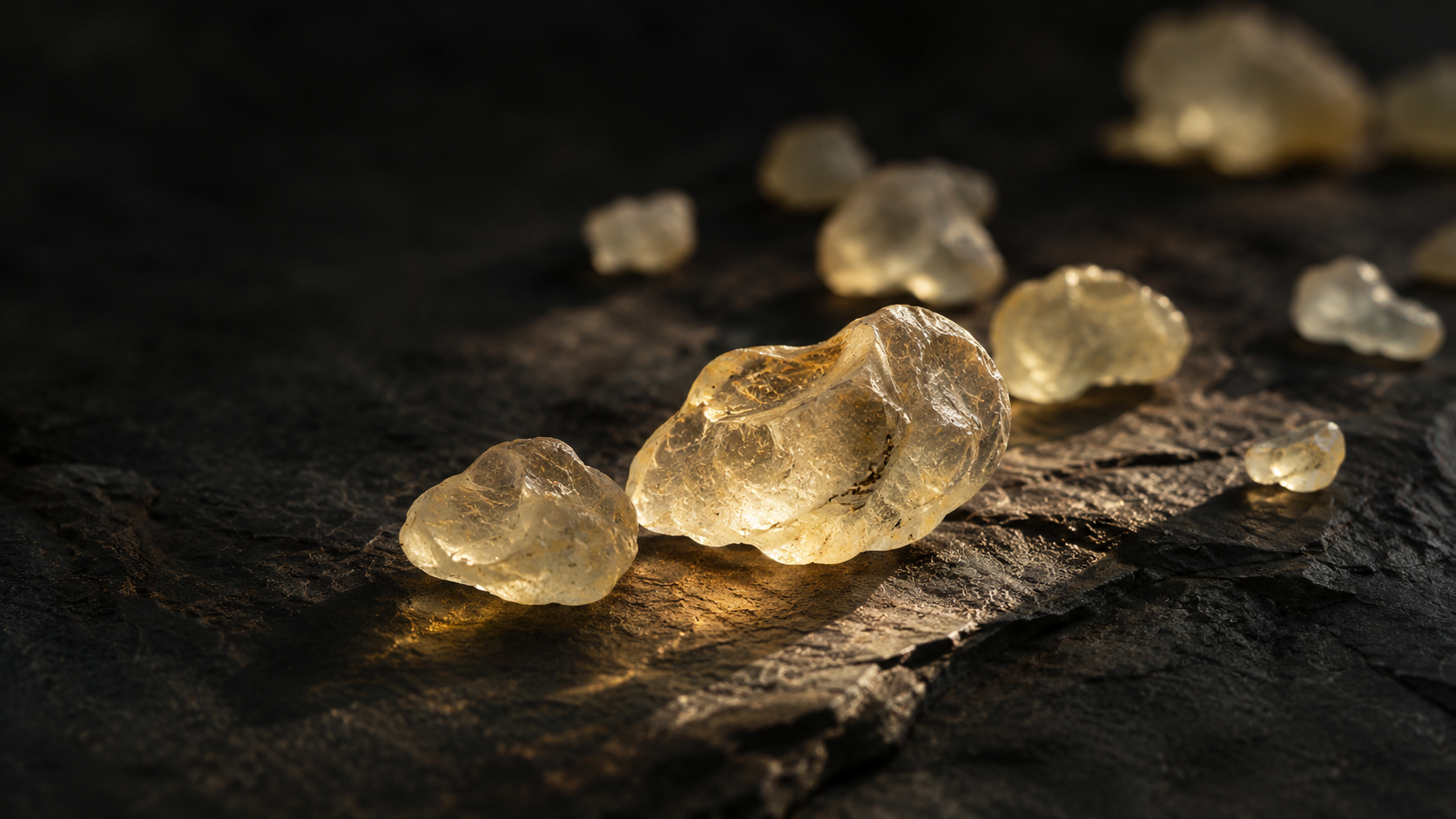
A small tear of resin. Thousands of years of history. And a natural ingredient that continues to attract scientific interest.
In southern Chios, a distinctive tree produces something rarely found elsewhere in the world: Chios mastic.
A natural resin with a characteristic scent, complex chemistry and a history dating back to antiquity.
Most people know it for its flavor. Fewer know that Chios mastic is also used in cosmetics, while researchers study the properties of its constituents and their potential skincare applications.
But what can it really offer the skin? And what do we know so far?
What is Chios mastic?
Chios mastic is a natural aromatic resin produced by the mastic tree (Pistacia lentiscus var. Chia), traditionally cultivated in southern Chios.
It is harvested through a process that has remained largely unchanged for centuries.
Growers make small incisions in the tree's trunk and branches. Resin seeps out and gradually hardens into the characteristic “tears” of mastic.
It is then collected, cleaned and graded with particular care.
Chios mastic has held Protected Designation of Origin (PDO) status since 1997. In 2014, the traditional knowledge of its cultivation was inscribed on UNESCO's Intangible Cultural Heritage list.
It is more than another plant ingredient. It is closely tied to a particular place, its people and a long tradition.
Chios mastic and skin: what are its properties?
Interest in Chios mastic for facial care relates mainly to its chemical composition.
The resin contains various natural compounds, including triterpenes and aromatic constituents, that are the subject of scientific research.
1. Antioxidant potential
Skin is exposed daily to environmental factors such as air pollution and ultraviolet radiation.
These can contribute to oxidative stress, a process associated with premature skin aging.
Some mastic constituents and extracts have shown antioxidant activity in laboratory studies.
This creates interest in their use in cosmetic formulations.
However, laboratory antioxidant activity alone does not prove that a mastic product protects human skin from premature aging.
2. Interest in the appearance of fine lines
One interesting research area concerns the relationship between certain mastic compounds and enzymes involved in breaking down structural skin proteins.
Collagen and elastin are important for skin structure and elasticity.
A scientific study published in 2024 in the journal Cosmetics examined Chios mastic's chemical composition and the activity of its constituents against collagenase and elastase enzymes.
Some fractions and compounds showed inhibitory activity in laboratory tests.
What does this mean for your face?
The results suggest mastic is an interesting subject for research into future cosmetic applications.
They do not prove that a mastic cream reduces wrinkles, increases collagen or firms the skin.
Such conclusions require human clinical studies and assessment of the final cosmetic formulation.
3. Antimicrobial activity
Chios mastic has also been studied for the antimicrobial activity of certain extracts and constituents.
This is a research area of interest to the cosmetics industry.
However, antimicrobial activity in laboratory conditions does not mean mastic treats acne or cures skin infections.
Acne is a complex dermatological condition that requires appropriate care.
4. A natural ingredient for modern cosmetic formulas
Mastic can be used in different forms, including extracts and derivatives, depending on the purpose of the cosmetic formula.
The chosen form, concentration, stability and compatibility with other ingredients determine its function in the final product.
Why does this matter?
Because an ingredient's properties are not automatically proven properties of every product containing it.
Chios mastic for the face: what does science actually say?
Chios mastic has a significant history of use and an interesting chemical composition.
But tradition and scientific evidence are not the same thing.
Through chemical analysis and laboratory biological evaluation, the study by Stamou and colleagues (2024) highlighted the potential of specific mastic constituents for cosmetic applications.
This is a positive research step.
It is not clinical proof of anti-aging effectiveness.
A cosmetic formula's actual value depends on the whole formulation and the data supporting its specific claims.
Why does Chios mastic belong in the PRIMAL CORE philosophy?
At PRIMAL CORE, we believe skincare does not need to be complicated.
You do not necessarily need a ten-step routine or dozens of different products.
You need everyday care that meets your skin's needs.
That is why, when developing our formula, we chose to explore the combination of two different natural raw materials:
Beef tallow: A fatty-acid-rich animal fat that can serve as a base for a rich, emollient cosmetic formula.
Chios mastic: A Greek natural resin with distinctive chemistry, history and research interest for cosmetic applications.
Our goal is to develop a balm that prioritises simplicity of formulation and everyday care for dry skin.
No unnecessary complexity.
No promises we cannot substantiate.
Only the essentials.
Is Chios mastic suitable for every skin type?
As with any plant-derived cosmetic ingredient, mastic is not necessarily suitable for everyone.
Tolerance depends on the ingredient's form, concentration, the overall formula and the skin's individual needs.
People with sensitive skin or known allergies should carefully review the formulas of the products they use.
An ingredient's natural origin does not guarantee it cannot cause irritation.
Frequently asked questions about Chios mastic
Is Chios mastic good for the face?
Mastic contains natural compounds with interesting properties being studied for cosmetic applications. Potential facial benefits depend on the product's final formula and supporting scientific evidence.
Does Chios mastic help with wrinkles?
Laboratory studies have examined how its constituents affect enzymes associated with collagen and elastin breakdown. These studies do not provide sufficient clinical evidence to claim that mastic reduces wrinkles on the human face.
Is Chios mastic suitable for dry skin?
Suitability depends on the overall cosmetic formula. A balm containing mastic may also include emollient lipids that help skin maintain its softness.
Can Chios mastic be used every day?
This depends on the specific product, its directions and skin tolerance. Applying raw resin directly to the face without appropriate cosmetic processing is not recommended.
Returning to the essentials
Chios mastic does not need exaggerated promises to be interesting.
Its unique origin, traditional harvesting and distinctive chemistry already provide reasons to explore it as an ingredient in modern skincare.
At PRIMAL CORE, this is the direction we follow.
Less complexity. Carefully selected raw materials. More substance.
PRIMAL CORE — Skincare, back to essentials.
PRIMAL CORE is under development. Join the Early Access List to be the first to hear about its progress and availability.
Sources and further reading
- Stamou, P. et al. (2024). Revealing the Potential of Chios Mastic Gum and Its Constituents for Cosmetic Applications through Chemical Profiling and Biological Evaluation. Cosmetics, 11(5), 155.
- UNESCO (2014). Know-how of cultivating mastic on the island of Chios.
- European Commission. Masticha Chiou — Protected Designation of Origin (PDO).
- Chios Mastiha Growers Association — Information about mastic's origin, production and cultivation.